 Factonia
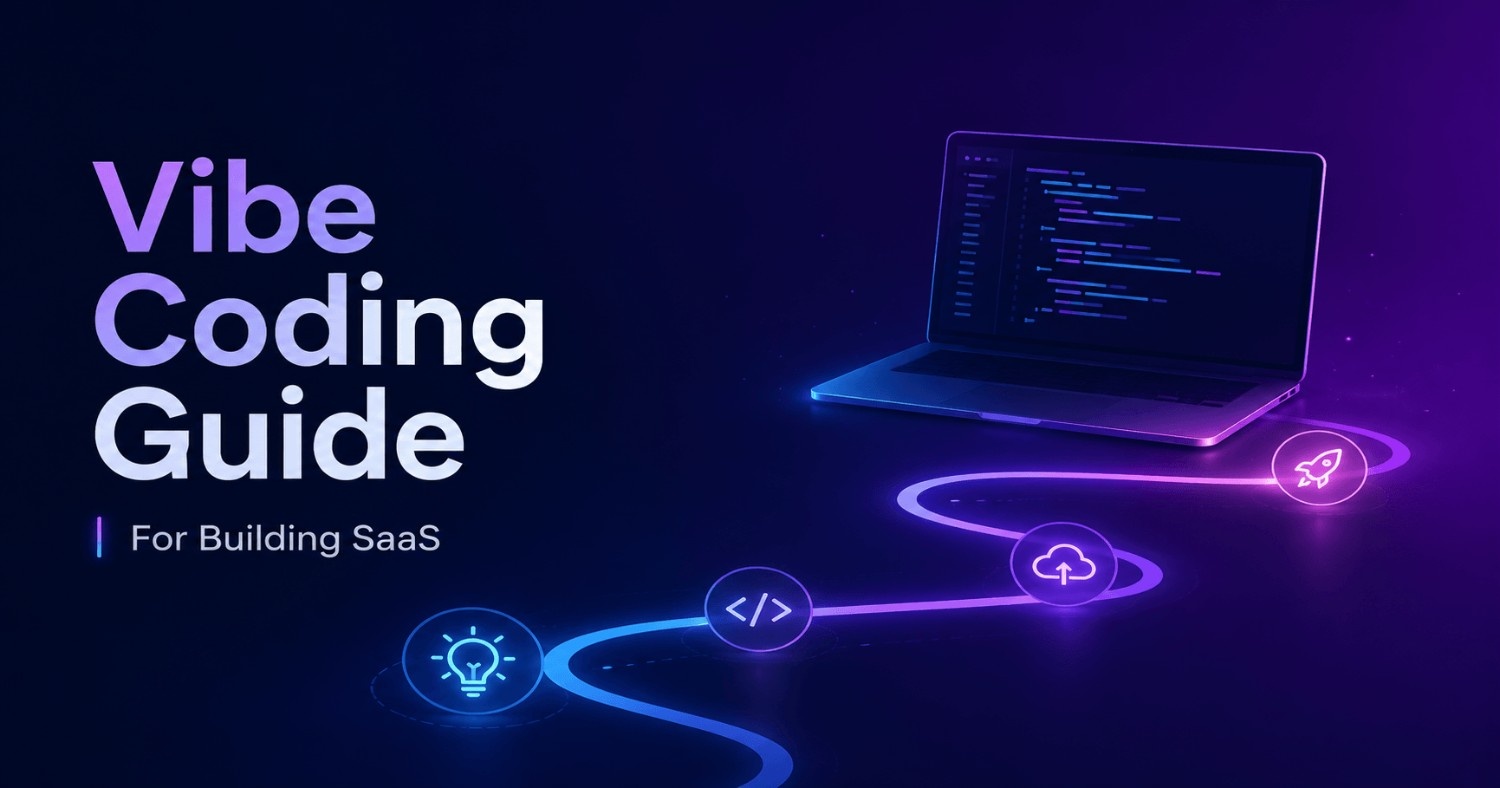
Vibe Coding Guide: A Professional Workflow for Building SaaS
Vibe coding, or intent-based engineering, is a software development workflow where developers direct AI agents to build applications using natural language. This guide details how to move from a raw idea to a production-ready SaaS product using structured prompting, modular architecture, and agentic feedback loops.
In short
Vibe coding, or intent-based engineering, is a software development workflow where developers direct AI agents to build applications using natural language. This guide details how to move from a raw idea to a production-ready SaaS product using structured prompting, modular architecture, and agentic feedback loops.
Table of contents
- Vibe Coding Guide: Building Production-Ready SaaS in 2026
- The Professional Vibe Coding Workflow
- 1. The Planning Phase (The "Zero-Line" Rule)
- 2. The Modular Prompting Framework
- 3. Iterative Feedback Loops
- Vibe Coding vs. Traditional Development: The Comparison
- Common Mistakes to Avoid
- Expert Tips for 2026 Development
- Final Takeaway
Vibe Coding Guide: Building Production-Ready SaaS in 2026
Vibe coding is a modern software development methodology where developers build applications by directing AI agents through natural language intent, rather than manual line-by-line coding. In 2026, it has transitioned from a prototyping technique to a legitimate method for shipping production-ready SaaS products. The core philosophy is "intent-based engineering": you function as the lead architect and project manager, providing vision, logic, and structural constraints, while AI agents handle the syntax, testing, and implementation.
The Professional Vibe Coding Workflow
The most common failure in vibe coding is treating the AI like an oracle that can generate an entire application from a single, vague prompt. Professional engineers treat AI as a distributed system of specialized agents.
1. The Planning Phase (The "Zero-Line" Rule)
Never start coding until the architecture is defined. AI agents struggle with coherence if they lack a "source of truth."
Create a
CLAUDE.mdorPROJECT.md: This file should contain your tech stack, folder structure, business rules, and design system.Define the Data Model First: Do not generate UI components until the database schema (e.g., PostgreSQL, Supabase, Convex) is defined. AI agents need to understand entity relationships before they can build functional frontends.
Use Boilerplates: Skip the "glue" code. Use proven SaaS starter kits for authentication, billing (Stripe), and multi-tenancy. Vibe-code your custom business logic, not the standard infrastructure.
2. The Modular Prompting Framework
Break feature implementation into the smallest possible tasks using the Context-Task-Constraint (CTC) model:
Context: Pinpoint the location. "We are working in the user-billing module. The schema is defined in schema.prisma."
Task: Be precise. "Add a usage_limit check to the billing webhook that throws a 403 error if the user exceeds their tier quota."
Constraint: Set boundaries. "Do not modify the auth controller. Use the existing check_quota() helper function. Keep changes contained to one file."
3. Iterative Feedback Loops
Vibe coding is not a one-shot process; it is a cycle of generation and verification.
Generate: Ask the agent to implement a small, modular feature.
Verify: Run tests immediately. Do not manually click through the UI to check for success.
Audit: If the agent hallucinates a function, do not re-prompt blindly. Provide the relevant documentation (or an
/llms.txtfile) and ask it to correct the specific file.
Vibe Coding vs. Traditional Development: The Comparison
1. Speed & Efficiency
Vibe Coding (Agentic): 5x – 10x faster for MVPs. Designed for rapid iteration.
Traditional Development: Slower; manual boilerplate and syntax-heavy processes.
2. Level of Control
Vibe Coding (Agentic): High control via architectural oversight. You are the architect; the agent is the builder.
Traditional Development: Absolute granular control. You manage every single line of code.
3. Maintenance & Cognitive Load
Vibe Coding (Agentic): Requires agent supervision and verification.
Traditional Development: High developer cognitive load; manual debugging and maintenance.
4. Best Use Case
Vibe Coding (Agentic): Ideal for SaaS MVPs, Tools, and Prototypes.
Traditional Development: Essential for complex, hyper-performant, and large-scale enterprise systems.
Common Mistakes to Avoid
Ignoring the Context Window: Feeding the AI your entire codebase for every prompt degrades performance and increases token costs. Use project-specific rules (like
.cursorrules) to keep the context relevant.Building "UFOs" (Unidentified Functional Objects): AI agents tend to over-engineer. Always prompt for the "simplest possible solution" that satisfies the requirement.
Trusting the First Draft: AI often duplicates functionality or imports unused libraries. Always include an "Audit step": “Audit this code for unused imports and logical redundancies before finalizing.”
Long-Running Threads: If an agent becomes erratic, start a fresh session. Starting with the current codebase state often resets the agent’s reasoning capability.
Expert Tips for 2026 Development
Leverage
llms.txt: If you are using a niche library, append/llms.txtto the documentation URL and feed that to your agent to provide "instant knowledge."Human-in-the-Loop Review: Use a secondary agent to audit the first. For example, use a coding agent to build the feature, then use a separate "Security Auditor" prompt to review the code for vulnerabilities.
Decouple Architecture: If your SaaS app becomes monolithic, break it into micro-services or sub-apps. It is easier to vibe-code three smaller apps than one "monster" app.
Testing as "Definition of Done": Never accept a feature as complete until the agent has also written the automated unit test for it.
Final Takeaway
Vibe coding is not about replacing developers; it is about scaling product intuition. By providing clear, modular prompts and enforcing strict architectural constraints, you can build production-grade SaaS products at a fraction of the traditional cost and time. The "vibe" comes from your ability to steer the agent, not just from the code it generates.
Frequently asked questions
What is vibe coding?
Vibe coding is a software development workflow where developers use natural language to direct AI agents to write, test, and deploy code, shifting the focus from manual syntax entry to high-level architectural intent.
Is vibe coding suitable for production apps?
Yes, in 2026, vibe coding is used for production SaaS. However, it requires a "human-in-the-loop" approach where developers provide structural constraints and verify all code through automated testing.
What is the best AI tool for vibe coding?
Common tools include Cursor, Replit, and Claude Code. The "best" tool depends on your stack, but Cursor is currently the standard for IDE-integrated agentic development.
How do I prevent AI agents from breaking my code?
Use the CTC (Context-Task-Constraint) model, build modularly, define your database schema before the UI, and always require the agent to write unit tests for every feature.
Does vibe coding replace traditional programming?
No, it changes the developer's role from "writer" to "editor and architect." You still need to understand logic, architecture, and system design to effectively steer the agents.

Editorial Team
The Factonia Editorial Team.