 Factonia
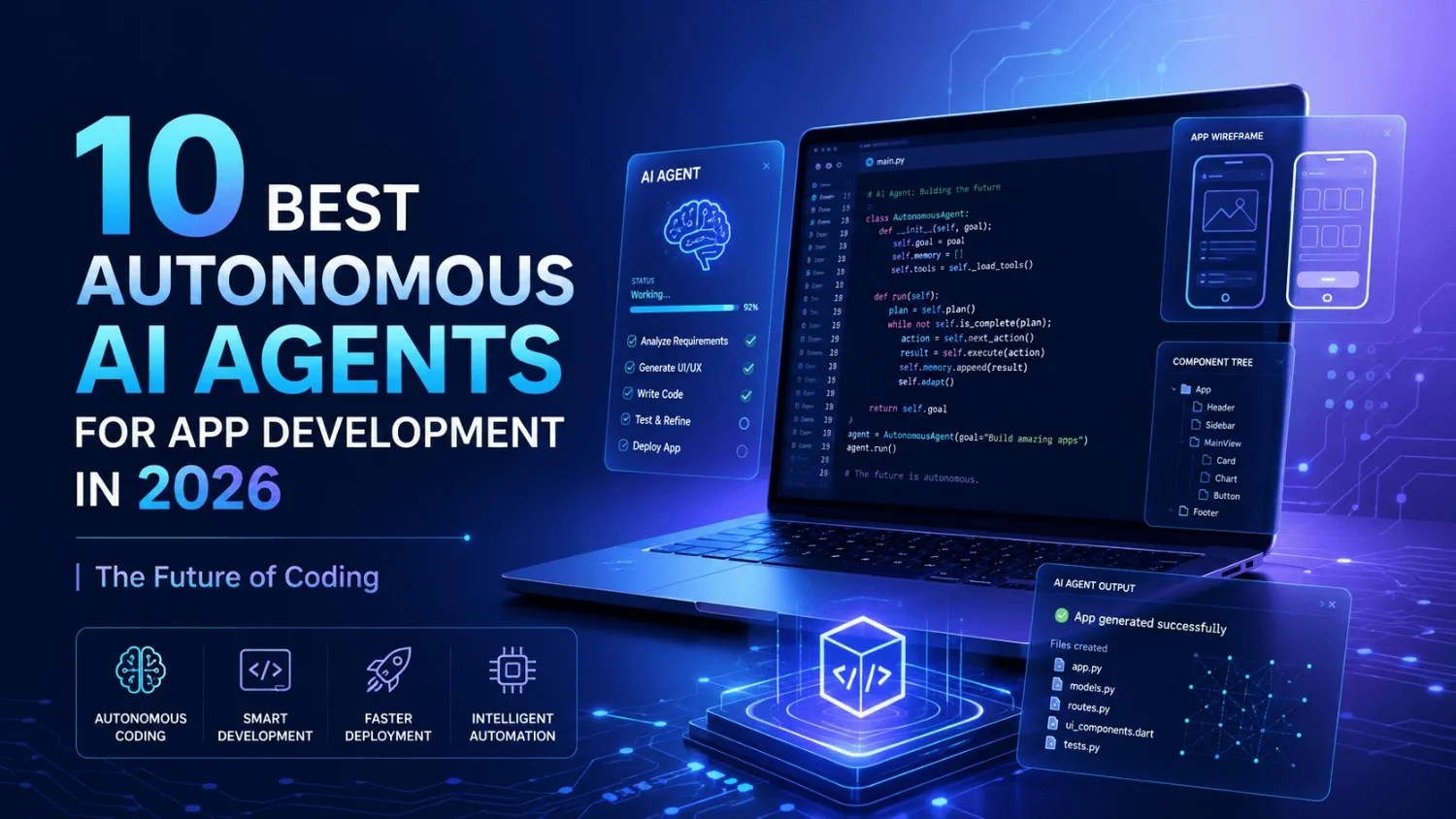
10 Best Autonomous AI Agents for App Development in 2026: A Developer’s Guide
Discover the 10 best autonomous AI agents for app development in 2026, from Devin AI to OpenDevin. Learn how these agents automate coding, debugging, and software architecture.
In short
Discover the 10 best autonomous AI agents for app development in 2026, from Devin AI to OpenDevin. Learn how these agents automate coding, debugging, and software architecture.
Table of contents
- The Evolution of Autonomous Agents in Software Engineering
- Top 10 Autonomous AI Agents for App Development in 2026
- 1. Devin AI (Cognition Labs)
- 2. AutoGPT-Next
- 3. Plandex
- 4. OpenDevin (All-Hands AI)
- 5. MetaGPT
- 6. GPT-Engineer (v2)
- 7. Aider
- 8. Goose (Block)
- 9. Sweep
- 10. Mendeley AI (Specialised for Backend)
- Comparative Overview: Leading AI Agents
- Devin AI vs AutoGPT for App Building: Which to Choose?
- Future of AI Agents in Software Engineering 2026
- How to Integrate Autonomous Agents into a Dev Team Workflow
- Key Takeaways for Indian Developers
- Conclusion
The 10 best autonomous AI agents for app development in 2026 include Devin AI, AutoGPT-Next, OpenDevin, and Plandex. These sophisticated tools can architect software, write full-stack code, and handle automated debugging. By leveraging multi-agent systems, these platforms allow developers to build complex mobile and web applications with minimal manual intervention, drastically reducing time-to-market.
The Evolution of Autonomous Agents in Software Engineering
By 2026, the shift from "AI assistants" like GitHub Copilot to "Autonomous AI Agents" is complete. While assistants recommend snippets, autonomous agents for mobile app development now function as digital engineers. They don't just suggest code; they plan the architecture, execute the terminal commands, manage the AI agent workflows for CI/CD pipelines, and even deploy the final product to local dev environments or the cloud.
For startups in tech hubs like Bengaluru or Gurgaon, this shift means a leaner team can achieve what used to require a dozen full-time developers. The focus has moved from syntax to generative AI agents for software architecture, where the human developer serves more as a Product Manager and High-level Reviewer.
Top 10 Autonomous AI Agents for App Development in 2026
Choosing the right agent depends on your stack, budget, and whether you require best open source AI agents for developers or managed enterprise solutions. Here is our curated list for 2026.
1. Devin AI (Cognition Labs)
Devin continues to lead the pack as the world's first fully autonomous AI software engineer. In 2026, it excels at end-to-end mobile app development. Unlike simple chat interfaces, Devin has its own browser, shell, and editor. It can research documentation for a new Indian payment gateway API like Razorpay or UPI and integrate it without help.
2. AutoGPT-Next
The evolution of the original AutoGPT, this version is specifically tuned for autonomous agents for React Native development. It uses a "Chain of Thought" reasoning process to break down complex UI requirements into modular components, making it a favorite for Indian startups building cross-platform apps.
3. Plandex
Plandex is a heavy-hitter for multi-agent systems for enterprise app dev. It focuses on large codebases. It can manage long-running tasks that span hundreds of files, making it the best AI agent for automated bug fixing in legacy systems. It works by creating a plan, executing it in a sandbox, and presenting a filtered diff for approval.
4. OpenDevin (All-Hands AI)
As the premier open-source alternative to Devin, OpenDevin has a massive community following. It is highly customizable, allowing companies to deploy AI agents on local dev environments to ensure data privacy—a crucial factor for Indian fintech and healthcare firms.
5. MetaGPT
MetaGPT treats a single prompt as a "Standard Operating Procedure." It assigns different roles (Product Manager, Architect, Coder, QA) to different internal agents. This multi-agent system is ideal for generative AI agents for software architecture, ensuring that the code is well-structured before the first line is even written.
6. GPT-Engineer (v2)
GPT-Engineer is designed for speed. It asks clarifying questions and then builds the entire folder structure of an app. In 2026, its ability to generate backend API generation via FastAPI or Node.js makes it a top choice for rapid prototyping and low-code autonomous agents for startups.
7. Aider
While often categorized as an editor tool, Aider’s 2026 autonomous mode allows it to pair-program inside your terminal. It is specifically optimized for AI agents for automated coding and debugging. Its "architect mode" helps refactor complex logic without breaking dependencies.
8. Goose (Block)
Goose is an open-source agentic framework that allows developers to automate repetitive engineering tasks. It's particularly strong in AI agent workflows for CI/CD pipelines, managing test suites and deployments across India-based servers or global CDNs autonomously.
9. Sweep
Sweep acts like a junior developer that lives in your GitHub repository. You describe a bug or a feature in a GitHub Issue, and Sweep writes the PR. It is arguably the best AI agent for automated bug fixing for teams that already have an established workflow but need more "hands" on deck.
10. Mendeley AI (Specialised for Backend)
Emerging as a niche leader, Mendeley excels at best AI agents for backend API generation. It understands complex database schemas and can autonomously generate secure, scalable GraphQL or REST APIs, including automated documentation.
Comparative Overview: Leading AI Agents
| Agent Name | Primary Strength | Deployment Mode | Best For |
|---|---|---|---|
| Devin AI | End-to-end Autonomy | Cloud/Managed | Full-stack Apps |
| OpenDevin | Open Source/Custom | Local/Cloud | Privacy-focused Dev |
| AutoGPT-Next | Rapid Prototyping | Local | React Native/Mobile |
| MetaGPT | Software Architecture | Cloud | Enterprise SOPs |
| Sweep | Issue-to-PR Flow | GitHub Logic | Bug Fixing |
Devin AI vs AutoGPT for App Building: Which to Choose?
The battle of Devin AI vs AutoGPT for app building usually comes down to cost and control. Devin is a premium "agent-as-a-service" that requires less setup but comes with a higher subscription cost. AutoGPT (and its successors) provides more granular control and can be run locally using your own LLM keys (like GPT-4o or Claude 3.5 Sonnet), making it more cost-effective for high-volume development in cost-sensitive markets like India.
Future of AI Agents in Software Engineering 2026
The future of AI agents in software engineering 2026 suggests a move toward "Self-Healing Code." Agents will not only build the app but monitor it in production. If a user in Mumbai experiences a 500-error, the agent will autonomously identify the log, write a fix, run tests in a staging environment, and deploy the patch—all before a human engineer wakes up.
"The developer of 2026 is no longer a writer of code, but an orchestrator of intelligent agents."
How to Integrate Autonomous Agents into a Dev Team Workflow
- Start Small: Use agents for unit test generation or documentation first.
- Define Guardrails: Use tools like OpenDevin on local environments to ensure sensitive API keys aren't leaked.
- Review, Don't Write: Shift your team's focus to reviewing PRs generated by agents rather than writing boilerplate code.
- CI/CD Integration: Connect your agents to your Jenkins or GitHub Actions to automate the AI agent workflows for CI/CD pipelines.
Key Takeaways for Indian Developers
- Autonomous agents for mobile app development can reduce development costs by up to 60%.
- Open source AI agents like OpenDevin are ideal for data-sensitive applications.
- Coding skills are still vital for system design and critical debugging, even if the agent writes 90% of the code.
- Multi-agent systems are the gold standard for enterprise-grade software architecture in 2026.
Conclusion
The landscape of the 10 best autonomous AI agents for app development in 2026 proves that the "AI revolution" has moved into its execution phase. Whether you are using Devin AI for mobile app development or deploying low-code autonomous agents for startups, the efficiency gains are undeniable. For developers in India and beyond, staying relevant means mastering these tools to build faster, smarter, and more robust digital products.
Frequently asked questions
What are the best autonomous AI agents for coding in 2026?
In 2026, Devin AI, AutoGPT-Next, and OpenDevin lead the market. These agents are capable of handling full-stack development, managing their own terminal and browser to solve complex engineering tasks.
Can AI agents build a full-stack app from scratch?
Yes, autonomous AI agents can now build full-stack applications from scratch by architecting the database, generating backend APIs, and creating responsive frontends based on natural language prompts.
How to use Devin AI for mobile app development?
To use Devin AI for mobile development, you provide it with a project brief. Devin then researches the required libraries (like Flutter or React Native), writes the code, and tests the app in a virtual environment.
Are autonomous AI agents better than GitHub Copilot?
Autonomous agents are often more powerful than Copilot because they can execute commands and solve multi-step problems independently, whereas GitHub Copilot primarily functions as a sophisticated autocomplete tool.
What is the cost of running autonomous AI agents for development?
While many tools like OpenDevin are open-source, you still need to pay for LLM API usage (like GPT-4 or Claude). Professional managed versions of agents usually cost between $15 to $500 per month depending on usage.

Editorial Team
The Factonia Editorial Team.